The Promise Versus the Reality
GitHub Copilot Workspace reached general availability in late 2025, and the marketing materials were compelling. End-to-end task completion. From issue description to merged pull request. All without leaving the browser. Over 1.8 million developers adopted it within the first six months, which tells you something about the hunger in the market for tools that promise to compress the cognitive load of software development. I understand that hunger. I’ve felt it myself across twenty years of shipping code.
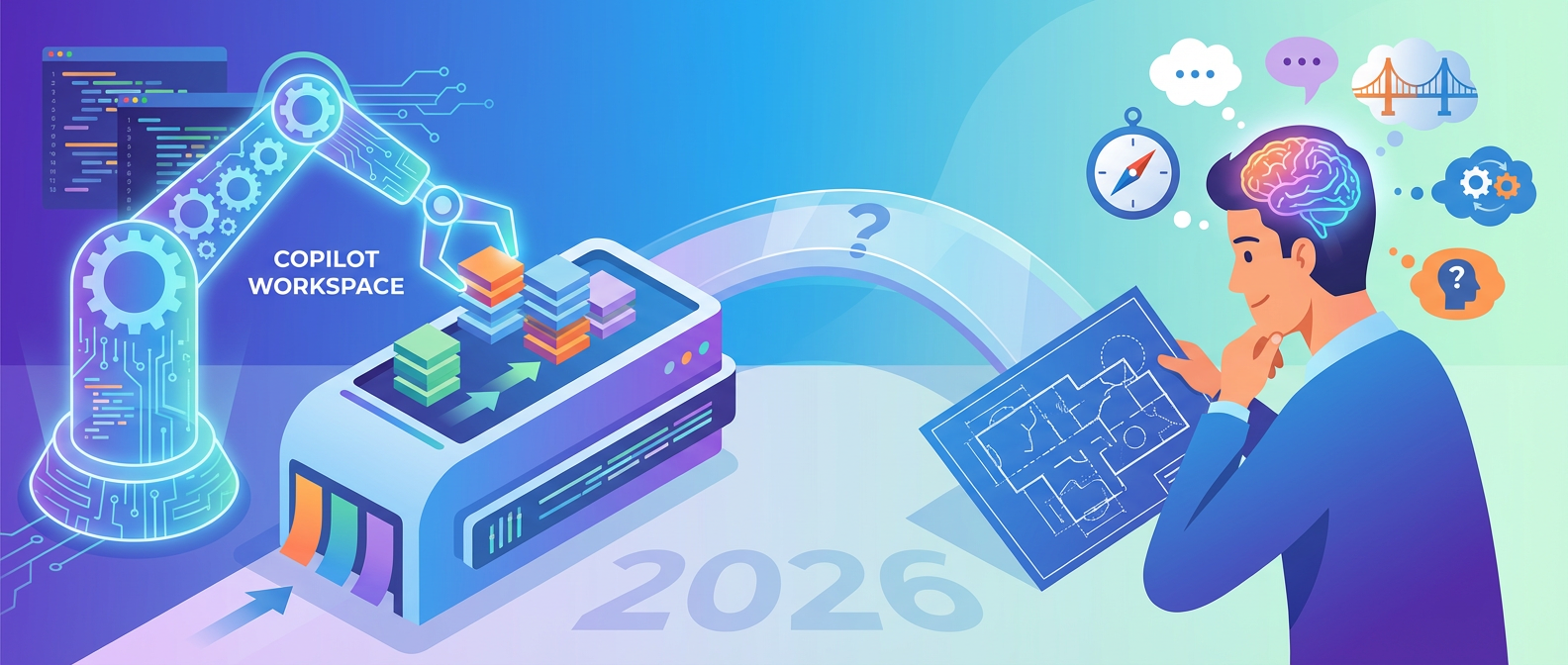
But hunger and reality are different things. I’ve spent the last few months watching how Copilot Workspace actually performs in the hands of capable teams, and what I’ve observed is a widening gap between what the tool can do and what senior engineers still need to do. The gap isn’t shrinking. If anything, it’s becoming more obvious.

The 76% Admission Nobody Wants to Talk About
A Stack Overflow Developer Survey conducted in late 2025 found something uncomfortable: 76% of developers actively using AI coding tools reported spending significant time fixing logic errors in AI-generated code intended for production or production-adjacent systems. Let that number sit for a moment. Three-quarters of the user base is spending material time on remediation work. That’s not a feature. That’s a tax on productivity that most teams are quietly absorbing without quite articulating what’s happening.
The errors follow predictable patterns once you start tracking them. Off-by-one mistakes in loop constructs. State management that works in isolation but breaks under concurrent access. Edge cases in data transformation logic that the AI never encountered during training. These aren’t exotic failures. They’re the kind of mistakes a mid-level engineer spots in a five-minute code review, and the kind a senior engineer prevents through architecture decisions made before a single line gets written.
Copilot Workspace doesn’t have access to your architecture decisions. It doesn’t know why you chose event sourcing over a traditional database transaction model. It doesn’t understand the implicit contracts between your service boundaries. It sees code. It generates more code that locally looks coherent. That’s the extent of its sight.
The Code Churn Problem That Metrics Are Starting to Expose
GitClear published research in early 2026 that should be required reading for any engineering leader evaluating AI-assisted development at scale. Their analysis showed that codebases developed with AI assistance exhibited a 41% increase in code churn rates compared to pre-AI baselines. Code churn measures how often code gets rewritten shortly after being committed. High churn rates are a leading indicator of instability, technical debt accumulation, and team friction.
Think about what that metric is actually telling you. It’s not saying AI is writing bad code that gets thrown out immediately. It’s saying AI-generated code tends to require more rework, more iteration, more context-switching after the initial commit. A senior engineer doesn’t just write code that works today. A senior engineer writes code that survives contact with reality, which includes evolving requirements, edge cases discovered in production, and architectural constraints that only become visible after a feature ships.
You can read the full GitClear 2025 AI Code Quality Report if you want the methodological details, but the headline is clear: teams using Copilot Workspace are making more edits to recently written code, not fewer. The tool is creating work downstream, even when it appears to save time upstream.
Where the Boundary Actually Sits
This isn’t an indictment of Copilot Workspace. I’ve used it. It excels at specific, bounded tasks. Boilerplate generation. Test case scaffolding. Refactoring patterns that are well-established in your language ecosystem. The GitHub Copilot Workspace documentation lays out its capabilities honestly, and the tooling itself is well-engineered. My critique is directed at the narrative building around it, not the tool itself.
The competitive landscape is also moving quickly. Anthropic’s Claude 3.7 Sonnet, released in February 2026, introduced an extended thinking mode that outperformed GPT-4o on the SWE-bench Verified benchmark with a 70.3% resolution rate. That’s real progress. But it’s progress on a benchmark designed to measure code generation capability, not progress on the harder question: can an AI system understand the business context, the performance requirements, the security model, and the long-term maintainability needs that a senior engineer carries in their head through years of experience?
Senior engineer judgment is orthogonal to code generation capability. A senior engineer looks at a proposed solution and asks questions that an AI system has no training data for. Will this scale to 100 million records? What happens when the external API we depend on goes down? How will the team on-board to this code in two years when everyone who wrote it has moved on? These questions aren’t about whether the code runs. They’re about whether the code survives.
The Honest Conversation We Need to Have
I’m not claiming that AI coding tools are useless. They’re not. They’re useful now, more useful than eighteen months ago, and they’ll keep improving. But usefulness on bounded tasks is different from the kind of judgment that separates a senior engineer from everyone else on the team.
The hard truth is that AI tools amplify the capabilities of engineers who already know what they’re doing. They compress time spent on mechanical coding work. But they don’t replace the judgment that prevents you from building systems that fail under stress or become impossible to maintain. If anything, the 41% code churn increase suggests that teams using AI tools without that senior judgment layer are actually working harder, not easier.
The engineers thriving with AI assistance right now are the ones using it as a paired coding partner, not as an autonomous engineer. They verify the output. They think about architectural implications. They know the gaps in the tool’s reasoning and don’t let those gaps propagate into production systems. That’s expertise in application, not a limitation of the tool itself.
Where are you seeing this play out in your codebase? I’m genuinely curious whether your team’s experience matches what the data is showing, or whether you’ve found approaches that change the equation. Drop a note if you’ve got examples of Copilot Workspace driving real leverage without the downstream churn.