Why Distributed Systems Feel Impossible Until They Don’t
After fifteen years of building systems that span continents and handle millions of requests, I’ve watched countless developers stare at distributed architecture diagrams with the same expression I probably had when I first encountered them. The boxes and arrows look deceptively simple until you realize each arrow represents a potential failure point, and each box contains assumptions that will betray you at 3 AM on a Saturday.
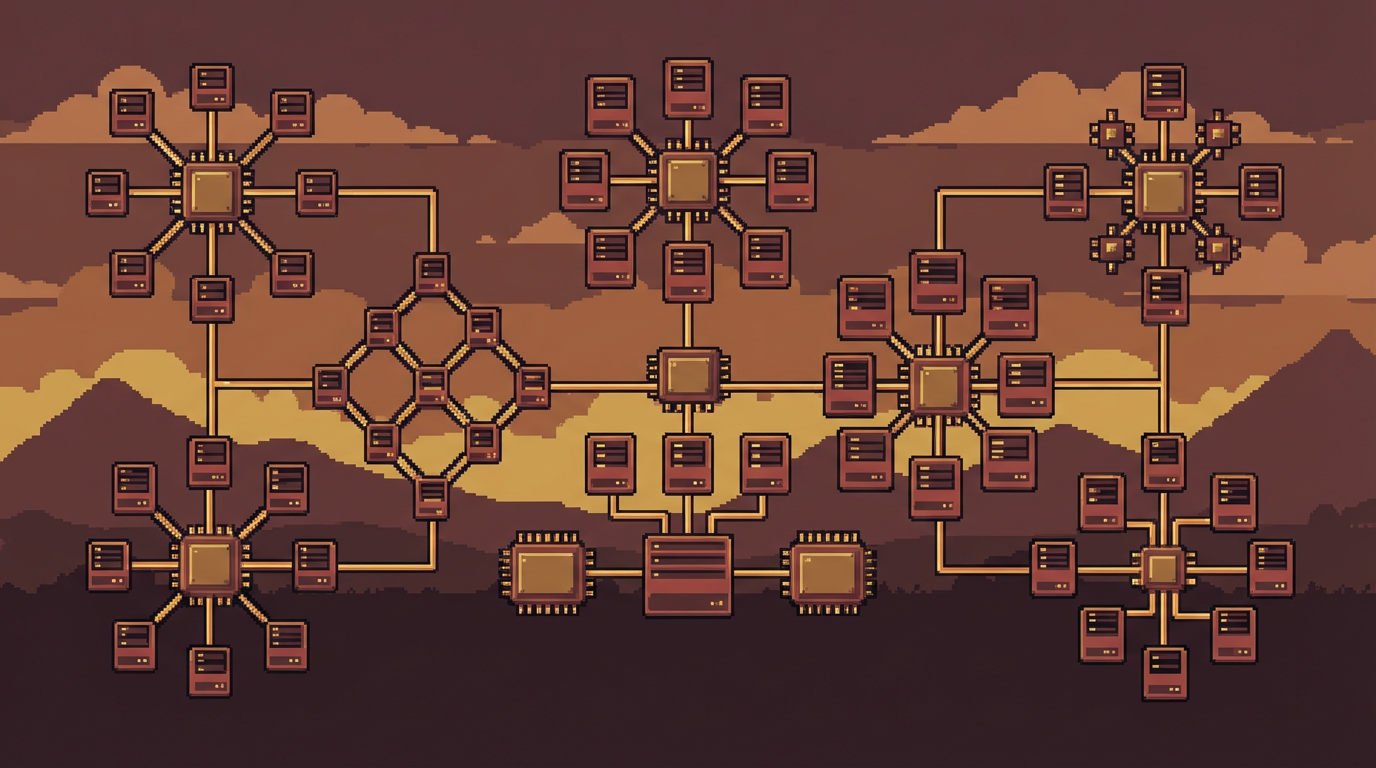
The truth is that distributed systems aren’t complex because engineers enjoy suffering. They’re complex because they solve genuinely hard problems: maintaining consistency across unreliable networks, ensuring availability when hardware fails, and scaling beyond what any single machine can handle. But here’s what I wish someone had told me when I started: you don’t need to solve all these problems at once.
The insight that changed everything for me came during a particularly brutal outage in 2018. While debugging a cascade failure across twelve microservices, I realized we had built a distributed system by accident. We started with a monolith, carved out a few services to solve immediate scaling bottlenecks, and suddenly found ourselves managing a network of interdependent components without any coherent strategy. That’s when I learned that successful distributed systems aren’t built through gradual decomposition. They’re designed with clear patterns from the beginning.

Start With the Load Balancer Pattern
If you’re going to build your first distributed system, start with the simplest pattern that actually teaches you something useful: the load balancer pattern. Take your existing application, deploy multiple identical instances behind a load balancer, and watch what breaks. This sounds almost trivial, but it immediately exposes every assumption your application makes about local state, shared resources, and session management.
I recommend starting with a simple round-robin load balancer, not because it’s the best algorithm, but because it’s predictable and debuggable. Use something like HAProxy or nginx, configure health checks that actually test your application’s readiness, and monitor response times across all instances. Within a week, you’ll discover that your application wasn’t as stateless as you thought. You’ll start thinking about where data lives and how it flows between components.
What I love about this pattern is that it scales your understanding along with your system. You’ll naturally encounter session affinity problems, learn about connection pooling, and start thinking about graceful degradation. When one instance starts responding slowly, you’ll see how it affects the entire pool. When you need to deploy updates without downtime, you’ll discover blue-green deployments. Each challenge builds on the previous one, creating a foundation for more complex patterns.
Database Replication Teaches You About Consistency
Once you’re comfortable with multiple application instances, the next pattern to master is database replication. This is where distributed systems get philosophically interesting because you’re forced to confront the fundamental tension between consistency and availability. Set up a primary database with one or more read replicas, direct your read traffic to the replicas, and prepare to learn about eventual consistency the hard way.
The first time you update a user’s profile and immediately redirect to a page that shows the old information, you’ll understand why read-after-write consistency matters. The first time a replica falls behind during high write traffic and your application starts showing stale data, you’ll appreciate why monitoring replication lag is critical. These aren’t abstract concepts when they’re breaking your application in real-time.
Start with MySQL or PostgreSQL replication, not because they’re the most sophisticated options, but because they’re well-documented and widely supported. Configure your application to route reads and writes appropriately, implement connection pooling to manage the additional database connections, and build monitoring that tracks both query performance and replication health. This pattern will teach you more about distributed systems than any amount of reading about CAP theorem.
Pay particular attention to how you handle replica failures. When a read replica goes down, does your application gracefully fall back to the primary, or does it start throwing errors? When the primary fails and you need to promote a replica, how long does that process take, and what happens to your application during the transition? These scenarios will happen in production. Experiencing them in a controlled environment builds the intuition you need for more complex systems.
Event-Driven Architecture for Loose Coupling
After you’ve mastered stateless applications and database replication, you’re ready for event-driven architecture. This pattern fundamentally changes how your components communicate, moving from synchronous request-response to asynchronous message passing. It’s more complex to implement correctly, but it’s also more resilient and scalable than direct service-to-service communication.
Start with a simple message queue like RabbitMQ or Amazon SQS. Pick one business process in your application, something like user registration or order processing, and implement it using events instead of direct database writes. When a user registers, publish a “UserRegistered” event. Have separate consumers that handle email verification, account setup, and analytics tracking. This forces you to think about message ordering, duplicate handling, and failure recovery.
The first challenge you’ll encounter is exactly-once processing. Messages will be delivered multiple times. Consumers will crash while processing events. You’ll need to make your handlers idempotent. This is where you’ll learn about message acknowledgments, dead letter queues, and the importance of including enough context in each event to process it independently.
Event-driven architecture also teaches you about system observability in ways that synchronous systems don’t. When a user registration takes five seconds, is the delay in the email service, the analytics service, or the message queue itself? You’ll need distributed tracing, correlation IDs, and careful attention to message timestamps. These skills directly transfer to more complex patterns like microservices and CQRS.
Caching Strategies That Scale
The final pattern I recommend mastering before moving to more advanced architectures is distributed caching. Caching seems simple until you’re debugging cache invalidation bugs at scale, trying to figure out why some users see updated data while others are stuck with stale information for hours.
Start with Redis or Memcached as an external cache layer. Begin by caching expensive database queries, but pay close attention to cache key design and invalidation strategies. Use cache-aside pattern initially, where your application explicitly manages what goes in and out of the cache. This gives you complete control and helps you understand the tradeoffs between cache hit rates and data consistency.
The real education comes when you start caching at multiple layers. Add HTTP caching headers for static content, implement application-level caching for computed results, and use database query caching for frequently accessed data. Now you have a distributed caching hierarchy, and you need to think about cache coherence, invalidation cascades, and the performance implications of cache misses.
Watch what happens when your cache cluster fails. Does your application gracefully degrade to handling uncached requests, or does it fall over because it can’t handle the database load? This scenario will teach you about circuit breakers, bulkhead patterns, and the importance of designing for failure from the beginning.
These four patterns form the foundation of every distributed system I’ve built. Master them first, understand their failure modes, and build the operational muscle memory for monitoring and debugging them. Once you’re comfortable with load balancing, replication, events, and caching, you’ll find that more complex patterns like microservices and event sourcing are really just sophisticated combinations of these building blocks. The path from here leads through service meshes, distributed databases, and eventually to the kind of large-scale systems that initially seemed impossible. But that’s a journey for another article.