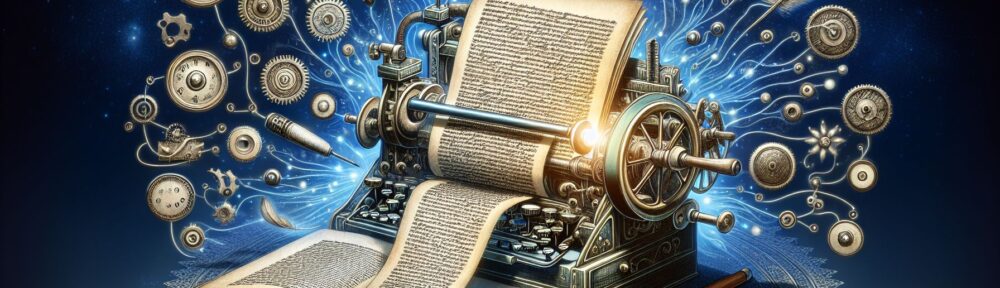
Hey there, fellow tech enthusiasts! Today, I’m jumping into one of the most exciting fields where artificial intelligence isn’t just a tool but a co-creator: AI in creative arts. I’ve always been a fan of good storytelling and, frankly, a bit of a sci-fi junkie. So, when I heard that AI might be taking the helm in crafting narratives, my curiosity was piqued. Could a machine really write something I’d binge-read through the night? Let’s find out!
The Spark of AI Creativity
First off, let’s talk about how AI has been dipping its toes into the creative pool. OpenAI’s GPT models have been pretty revolutionary, don’t you think? These models take a shot at everything from drafting novels to composing poetry. They do it by training on a massive dataset of human writing, learning the patterns of language, style, and even humor. It’s like they’re mini-literary scholars, except they never sleep or procrastinate (would be a dream to have in college, right?).
These AI models start by copying human writing styles, but what’s fascinating is how some of them start developing their own quirks. It’s almost creepy. Like seeing your kid pick up a guitar and play riffs you never had the patience to teach them.
Real-World Applications
Let’s get down to brass tacks here. How is AI storytelling shaking things up in the real world? Well, several companies have been experimenting with AI in content creation for a while now. Take ScriptBook, for instance. They’ve been using AI to predict how well a script might perform in Hollywood. It’s like having a crystal ball that speaks movie.
Meanwhile, AI has been helping the journalism industry by automating the more formulaic content (think annual summaries or local sports scores) so journalists can focus on the hard-hitting stuff. The Associated Press has been doing this quite successfully for years, freeing up resources for more investigative work.
Challenges Along the Way
Of course, it would be naive to think it’s all rainbows and unicorns. AI storytelling faces some real challenges. First, there’s that pesky issue of creativity. Machines thrive on logic and pattern recognition, yet storytelling is about breaking patterns and introducing novel ideas. As someone who’s written stories only for my beta readers to call them “unexpected but confusing”, I can sympathize with the challenge AI faces here.
Second, there’s the question of authenticity. Will a story resonate if we know it’s created by an algorithm? Does a beautifully crafted narrative lose its luster if those fleeting sparks of human insight are absent? We humans are biased towards our own handiwork, aren’t we? It’s like preferring home-cooked meals even if they’re less ‘Michelin Star’. They taste like love or, at the very least, effort.
The Future of AI Storytelling
Now, let’s take a moment to peer into the future. It’s almost like asking a robot to read your fortune (don’t try this at home, folks). AI is getting smarter, no doubt. As machine learning algorithms become more sophisticated, they might start to bridge the gap between mere aggregation of existing ideas and genuine innovation.
Imagine collaborating with an AI to create your next novel, or letting an AI push the boundaries of creativity in ways we haven’t even dreamt of. I’m not saying we’ll all have AI co-authors by 2030, but the possibility is tantalizing. It might even lead to new art forms. Genres that blend the calculated precision of machines with the emotional depth of human insights.
Conclusion: Humans and Machines, Together
So, where does that leave us? Honestly, I believe the future of storytelling is a partnership between humans and machines. AI can spark ideas, keep meandering plotlines in check, or potentially even help hone our own creative processes. It’s not about replacing authors but making our capabilities stronger.
After all, technology’s greatest purpose has always been to extend human reach. To help us do things better, faster, and sometimes just more artistically. As we stand on this edge of digital creativity, it’s exciting to think about what stories we’ll tell and the new horizons we’ll explore. Not just through the tales themselves, but through the very act of creation.
Isn’t it funny how we once thought the only machine that could write was a typewriter? Now, we’ve got entire software that can scribble stories while we focus on sipping our coffee. As a lifelong fan of good narratives, I’m eager to see what chapter this technology will throw us into next.
Let me know what you think about AI in storytelling. Love it? Dread it? Or just intrigued? Share your thoughts. After all, there’s no story without a lively discussion!