The Quiet Release That Changes How We Think About AI Code
When Anthropic shipped Claude 3.7 Sonnet in February 2025, the announcement landed without the usual fanfare. No press conference. No coordinated media blitz. Just a capable model with an unusual new feature called extended thinking mode. I’ve been in this industry long enough to know that the most important shifts often arrive unannounced. They come from teams confident enough in their work to let the performance speak first and the narrative follow.
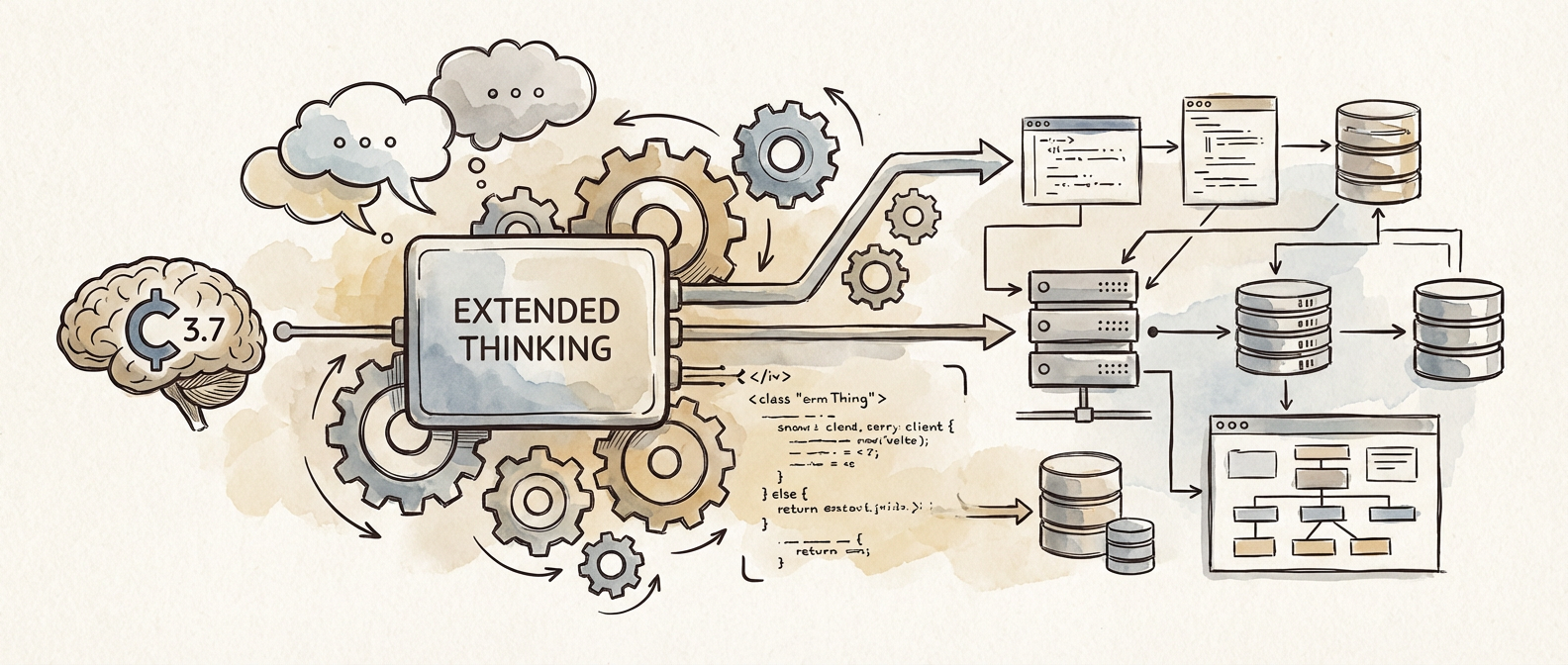
Extended thinking mode is straightforward in concept but interesting in implication. The model can now reason through a problem for up to 128,000 tokens before it outputs anything you see. That’s the equivalent of a very long internal monologue happening in the background. For those of us who’ve spent years debugging production systems, the metaphor is obvious: this is what happens when an experienced engineer sits quietly with a problem for twenty minutes before saying a word. The difference is that now your AI collaborator can do it too.

Real-World Performance Numbers That Matter
I’m naturally skeptical of benchmarks. They’re useful, sure, but they rarely capture what happens when you’re shipping features at 11 PM on a Tuesday. That said, the numbers on SWE-bench Verified leaderboard are worth taking seriously. Claude 3.7 Sonnet achieved 70.3% on real-world software engineering tasks in Anthropic’s testing. That puts it ahead of GPT-4o and Gemini 1.5 Pro. These aren’t toy problems. SWE-bench Verified pulls actual issues from live open-source repositories. Your code. My code. Code that matters.
Extended thinking mode is doing heavy lifting here. What’s happening under the hood is that the model can explore multiple approaches, backtrack, reconsider assumptions, and essentially think aloud before committing to an answer. In my experience, that’s exactly how the best code reviews work. Someone reads the proposed change, questions their first instinct, considers edge cases, and then offers a substantive response. We’re watching that behavior emerge from a language model.
The Production Reality: Latency as the Silent Cost
Here’s where I need to be direct with you. Extended thinking isn’t free. Nothing useful is. When you enable this mode on complex reasoning tasks, your average first-token response time climbs beyond 45 seconds. For some operations, it goes higher. If you’re accustomed to standard model responses arriving in two or three seconds, this is a material shift in how your systems behave.
I mention this not as a criticism but as the kind of engineering trade-off that should shape your decision-making. In a real-time chat interface, 45 seconds is an eternity. Users abandon contexts that slow. But in asynchronous workflows, CI/CD pipelines, code review automation, and background analysis systems, that latency becomes manageable. Acceptable. Worth it. The question isn’t whether extended thinking is fast. It isn’t. The question is whether the improvement in reasoning quality justifies the cost in your specific use case. That’s an architectural decision, not a feature decision.
Where Extended Thinking Produces Measurable Advantages
Developers on Hacker News and Reddit’s machine learning community have been running their own experiments. The pattern I’m seeing is consistent: when Claude 3.7 Sonnet uses extended thinking mode on queries about niche frameworks, lesser-known libraries, and non-standard APIs, it hallucinates those APIs less frequently. The informal tracking suggests error rates drop roughly 30% when the model has space to reason rather than answer immediately. That’s significant. Library hallucinations have been a persistent pain point in production AI-assisted development.
What’s likely happening is that extended thinking allows the model to catch itself mid-reasoning. It can simulate what happens when it suggests a non-existent method call, recognize the inconsistency, and course-correct before output. This is hypothesis-testing behavior, and it translates directly to code that’s less likely to break at runtime because the AI suggested something that doesn’t exist.
The Broader Context: AI Code Completion at an Inflection Point
GitHub published data in late 2025 showing that AI-assisted code completion now accounts for over 40% of code committed by Copilot users, up from 25% just two years prior. That’s not gradual adoption. That’s acceleration. The industry is clearly betting that AI code assistance will be part of the standard developer toolkit. At the same time, the quality bar is rising. Users are demanding fewer bugs, fewer hallucinations, fewer false suggestions that waste time rather than save it.
Claude 3.7 Sonnet’s extended thinking mode addresses that demand directly. You get the speed of immediate response when you need it, and you get the deliberation of careful reasoning when the stakes justify it. The Anthropic Claude 3.7 Sonnet announcement includes specific details about safety considerations and reasoning limitations, which suggests they’ve thought through failure modes most teams haven’t even considered yet.
Why This Matters for Your Codebase
If you’re evaluating AI models for production code work, extended thinking mode shifts the calculation. It’s not about whether the model is faster or cheaper. It’s about whether, in the specific contexts where your team spends time, the improvement in reasoning quality is worth the latency trade-off. For code review automation, complex refactoring analysis, and identifying security issues in unfamiliar codebases, I suspect the answer is yes.
This is the kind of capability that doesn’t revolutionize the industry overnight. Teams will integrate it into their deployment pipelines, use it for the hard problems and faster models for routine work. The model will improve based on real-world feedback. In two years, we’ll look back and wonder why we thought 40-second reasoning times were unusual. I’ve seen this pattern before, and it usually means we’re watching something real rather than marketing noise.
I’d be interested to hear how extended thinking performs in your environment. What problems have you found where the model needs to think longer? Where does the latency actually become unacceptable for your workflows? Those are the details that separate theory from practice.