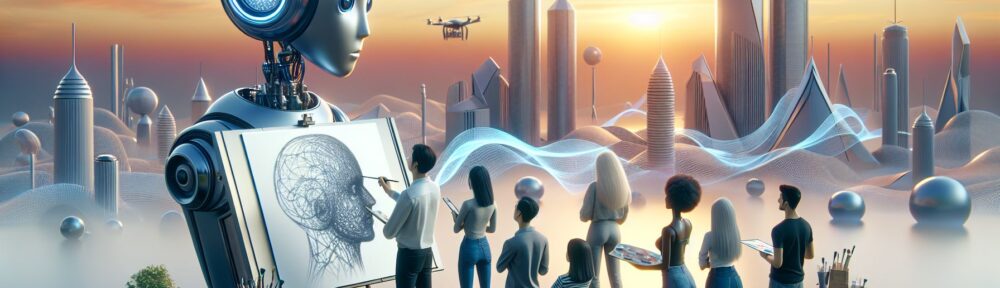
When Alexa sets our alarms and Siri pulls up our playlists, it feels pretty normal now. So maybe it shouldn’t surprise us that artificial intelligence is also making waves in creative industries. AI-powered artwork, machine-generated music, technology creating things we used to think only humans could make. It still sounds a bit like science fiction to me. But here we are, watching AI literally color outside the lines in ways that would have blown our minds just a few years ago.
The Convergence of Art and Algorithm
AI has always been incredible at processing massive amounts of data in seconds. Now it’s picking up a virtual brush and creating art. This makes me wonder: Can a machine-made painting or sculpture hit you in the gut the same way human art does? Artistic algorithms like GANs (Generative Adversarial Networks) and neural networks are learning to produce genuinely complex artworks. Remember that “Edmond de Belamy” painting created by AI? It sold for $432,500 at auction. That’s over 40 times what experts expected it would go for.
GANs: Portraitists of a New Era
Here’s how Generative Adversarial Networks work: two neural networks basically fight each other in a digital battle. One creates (the generator) while the other judges what it made (the discriminator). They keep going at it until the generated art looks so real you can’t tell it apart from human-made pieces. The results are often weird, abstract, and surprisingly innovative. Artists like Mario Klingemann and Refik Anadol are using GANs to create projects that make you question what art even is anymore.
Music in the Key of AI
AI isn’t stopping at visual art. It’s also diving into music. By analyzing huge datasets of existing compositions, AI can write symphonies that actually sound sophisticated. AIVA (Artificial Intelligence Virtual Artist) has been officially recognized as a composer. Think about that for a second. A machine that can compose music that makes you feel something. Whether it’s scoring a film or writing original pieces, AI music has moved way past the novelty stage.
AI as an Instrument
What’s interesting is how musicians are treating AI more like a collaborator than a threat. Tools like Google’s AI Experiments let artists use machine learning as just another instrument. The AI generates melodies or helps with songwriting, but it works with the artist’s vision instead of replacing it. I think this partnership approach could completely change how music gets made, shared, and experienced.
Writing and Storytelling: An AI Anthology
Then there’s writing. Tools like GPT-3 (Generative Pre-training Transformer 3) can write entire articles, poems, and stories. It uses deep learning to predict and generate text, which opens up crazy possibilities for writers while making us ask some tough questions about authorship and creativity.
Narrative Automation
GPT-3 can create coherent writing that mimics different styles and voices really well. Imagine having an AI co-author that never gets tired and always understands your novel’s theme. For journalists, it can handle basic article generation, freeing up time for deeper investigative work. Some people hate this idea of automating writing, but others see how it could make content creation more accessible and bring fresh storytelling approaches to the industry.
WordPress meets AI: Enhancements for Digital Creators
AI isn’t just for artists and composers. It’s changing web content creation too. WordPress now has AI plugins that help streamline blog content and optimize SEO strategies. AI-enabled platforms can boost site engagement, improve search rankings, and refine user experience more efficiently than we could manage manually.
SEO and Content Generation: A Tech-Driven Renaissance
With natural language processing (NLP), AI can tailor content to engage audiences more effectively. These systems analyze user data to figure out the best posting times, suggest keywords for better visibility, and customize formatting for mobile users. This comprehensive approach is making digital engagement strategies more dynamic and interactive than ever.
The Ethical Canvas: AI’s Challenges and Responsibilities
We can’t talk about AI in creative industries without addressing the ethical concerns. Automating creative processes raises real worries about job displacement, intellectual property rights, and whether we’re devaluing human creativity. There’s an ongoing debate about whether AI-generated works should be credited to the machines or the people who built them. Finding the right balance means creating policies that protect creators while still embracing technological advancement.
Crafting Ethical Boundaries
Ethical AI practices require transparency and inclusivity. Companies and creators need to work together to establish guidelines that protect human contributions while encouraging innovation. As AI gets more sophisticated, ethical use will depend on our ability to maintain humanity’s voice within this growing digital chorus.
Conclusion: Beyond the Horizon
The AI revolution in creative industries opens up so many possibilities, but it also raises endless questions: What will art look like when machines are creators? Will AI-enhanced stories make us laugh and cry? We’re standing at this crossroads of technology and creativity, and honestly, the future feels both promising and paradoxical.
The relationship between AI and art isn’t an ending. It’s this ongoing, evolving journey. By partnering with our digital counterparts, creators can expand what they imagine and capture, blurring the lines between human and machine in ways that create something entirely new.
As we think about what comes next, this feels like a moment worth celebrating. It’s enriching cultural diversity, elevating human potential, and creating a more inclusive vision of creativity. For enthusiasts, entrepreneurs, and creators: let’s keep this conversation going and explore these colorful realms where imagination meets innovation.